
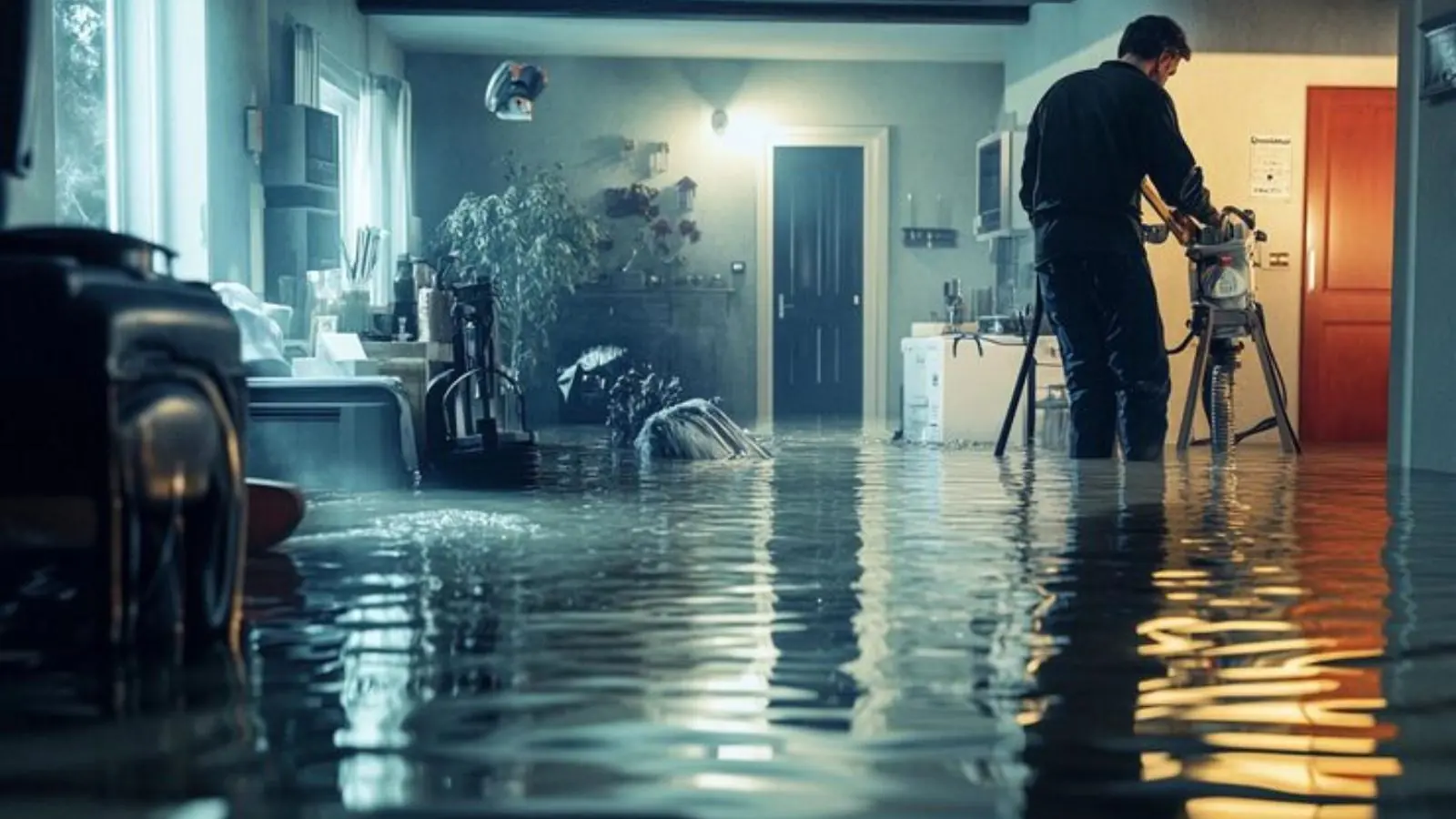
Water mitigation is the emergency work that keeps a wet building from getting worse: stop the source, remove the water, and start drying whatever can be saved. Our dispatch line for Harbor City runs 24/7 at (424) 550-5662.
While you wait for a call back, close the main water valve, lift valuables and electronics onto dry surfaces, and keep people and pets out of any dirty water. Turn off power to wet areas only if the panel is reachable without stepping in water. We do not promise an arrival time, but we do arrange a same-day response when one is available.
Wet drywall, musty smell, carpet still damp?
Those are the signs that water got past the surface and into the wall cavity, the carpet pad and the subfloor. The trade term for the fix is water mitigation: controlled extraction, drying and monitoring that begin before any rebuilding. A box fan and an open window rarely reach moisture trapped behind baseboards, and that trapped moisture is what turns a small leak into a mold question after the first 24 to 48 hours.
When water damage becomes an emergency
A loss is an emergency when water is still spreading, when it reaches anything electrical, or when porous materials stay wet past roughly 48 hours. Drywall paper, carpet pad and insulation pull water upward and sideways by wicking, so a puddle in one corner can soak a wall two feet away.
Here is how the first 72 hours usually run when mitigation starts promptly. Timing varies with the size of the loss and the materials involved.
Hour 0: stop the source
Close the fixture stop, the branch valve or the main water valve. If a pipe is still running and you cannot find the valve, tell us on the phone and we will talk through the usual places, such as the meter box near the street.
First hours: start extraction
Standing water comes out first with pumps or extraction units, because every gallon left behind has to evaporate later. Wet carpet is extracted in slow passes, and we tell you at once if the pad is beyond saving.
Day 1: set the drying system
Air movers go on wet walls and floors, LGR dehumidifiers go into the affected rooms. Doors to dry areas stay shut so the equipment works on one volume of air.
Days 2 and 3: map and monitor
Moisture readings are logged on a sketch of the floor plan and compared with a dry reference reading. A thermal imaging camera helps spot damp patches behind finished surfaces.
Water near anything electrical
If water has reached an outlet, a panel or a ceiling light, stay out of the room. Flip breakers for wet circuits only when you can reach the panel without stepping in water, and leave anything that sparks, buzzes or smells like gas to the utility or 911.
If the room still has water standing in it, emergency water removal with pumps and extraction units comes first, and mitigation picks up from there. Most real losses need both.
Harbor City details that shape the plan
ZIP 90710 holds 26,761 residents and 9,912 housing units, according to Census Bureau ACS figures. Every one of those units has a water heater, supply lines, a washer hookup and drains that can fail. We do not assume a pipe type or a building age before we arrive, so moisture readings decide the plan.
Harbor City runs from Sepulveda Boulevard in the north to Anaheim Street and Palos Verdes Drive in the south, with Western Avenue and the Harbor Freeway (I-110) on the east side. Give the dispatcher your cross streets and ZIP when you call, because that is how the job gets placed on the schedule.
If the water is coming from the street side of your meter, that is a utility problem. LADWP lists a water main break line at 1-800-DIAL-DWP (1-800-342-5397), and no crew can dry a building while a main is still feeding it. Call them, then call us for the inside.
Signs of hidden water and how it is measured
Baseboards lifting, paint bubbling
Blistered paint and baseboards pulling off the wall mean moisture has sat inside the cavity for a while. The drywall paper behind the finish is probably wet.
Carpet that feels cool and spongy
Evaporation cools the surface. A pad is a sponge, and it keeps holding water long after the carpet top feels dry.
A musty smell with nothing visible
Odor without a stain usually points to a wet cavity, subfloor or insulation. A moisture meter finds it faster than opening walls at random.
Cupped hardwood boards
Cupping, where board edges rise, usually means moisture arrived from below. Boards can sometimes settle back once the subfloor dries, but only after a quick start.
Pin and pinless moisture meters give a number for each material, and a thermal imaging camera shows cool, damp patches behind paint and under flooring. The camera finds where to look. The meter says how wet it is.
Readings are marked on a floor plan sketch and backed by dated photos, which together form the moisture map. The same points are read again on each visit, so you can watch the numbers fall. That record also gives your insurer something concrete to review.
Call the 24/7 line and describe what is wet. We will tell you what to do first and arrange the next step.
Structural Drying
Structural drying is controlled evaporation. Wet materials release water into the air, air movers push that moisture off the surface, and LGR dehumidifiers pull it out of the room so it cannot settle back into drywall, framing or carpet. The target is a dry standard for each material, not a room that merely feels dry.
We place air movers along wet walls and across wet floors, angled so air skims the surface, and size dehumidifiers to the air volume of the affected rooms. Under hardwood or tile, mat and injectidry systems pull air through the cavity where fans cannot reach. Sometimes a baseboard comes off or a few small holes are cut so air can enter the wall.
Drying typically takes about three to five days, and dense materials such as hardwood or plaster can run longer. We return to log readings, and equipment leaves only when materials reach the goal set from a dry reference reading elsewhere in the home.
What changes the scope of water mitigation
| Cost factor | How it changes the scope |
|---|---|
| Water category | Category 1 clean water can often be dried in place. Category 2 and 3 water usually means removing porous materials first. |
| Affected area | More rooms and more wall height means more equipment and more drying days. |
| Materials involved | Carpet and pad, drywall, hardwood, plaster and insulation each dry at a different pace, or have to come out. |
| Drying days and equipment | Air movers and LGR dehumidifiers are sized per area, and dense materials extend the run. |
| Rebuild scope | Mitigation ends when materials are dry. Replacing removed drywall, trim and flooring is a separate repair scope. |
Homeowners insurance often responds to sudden and accidental water damage, while gradual leaks and neglect often are excluded, so check your policy or ask your insurer. Our dated photos and moisture logs are documentation you can hand to your insurer. Want your real number? Call (424) 550-5662.
Dry in place or tear out?
Not every wet material has to be removed, and not every dry-looking one is safe to keep. This table shows the usual dividing lines.
| Material | Often dried in place when | Often removed when |
|---|---|---|
| Drywall | The water was clean, the wall has been wet less than about 48 hours, and the board is not swollen | The water was Category 2 or 3, or the board has swollen and softened |
| Carpet and pad | Clean water, short exposure, and the pad can be replaced while the carpet is saved | Contaminated water or a long soak, where the pad is usually the first thing to go |
| Hardwood | Mat or injectidry drying starts quickly and cupping is mild | Boards have crowned, buckled or darkened |
| Insulation | It is foam board that sheds water | It is batt insulation that stayed saturated |
| Baseboards and trim | Solid wood with clean water and an intact finish | Pressed fiber trim that has swollen |
Removal shortens drying but adds repair work, so we say which option we recommend and why. Anything pulled out is photographed first.
Getting a scope and price before work starts
Callers usually want a number first, and that is reasonable. The number depends on what the meters show, so an inspection is where it starts: we take moisture readings, photograph the affected rooms and note the materials involved.
From that we write the scope, covering the water category, the area, the equipment and the expected drying days, and we explain scope and price before work starts. When a crew is available we arrange a same-day response, though we do not promise an arrival time.
What happens after the equipment leaves
Dry readings close the mitigation job, not the whole project. Materials that were removed need water damage repair, and soaked belongings and surfaces need cleanup and sanitizing.
Neighbors in Wilmington, southeast of Harbor City and in ZIP 90744, reach the same dispatch line, and our Wilmington water damage page covers that area. If you sit on the border between two ZIPs, tell us both when you call.
Frequently asked questions
Do you handle water mitigation emergencies at night or on weekends in Harbor City?
Yes. A wet wall at 2 a.m. gets the same answer as one at noon, because the line at (424) 550-5662 is staffed around the clock, holidays included. Same-day response is offered when it is available, though no arrival time is promised. Give the dispatcher the address, which surfaces are wet and whether the source has been shut off.
My carpet is wet but the leak stopped. Do I still need mitigation?
Usually yes. A stopped leak leaves water in the pad, the tack strip area and sometimes the subfloor, and none of that dries quickly on its own. A moisture reading tells you whether drying equipment is needed or whether a short dry-out is enough.
Do you rent air movers or dehumidifiers?
No. We do not offer equipment rentals. We set, monitor and remove the air movers and LGR dehumidifiers as part of the job, because placement and run time decide whether materials actually dry. Typical drying runs about three to five days, and the real number follows the readings.
How is water mitigation different from water damage repair?
Mitigation stops the damage and dries the structure. Water damage repair rebuilds what had to be removed, such as drywall, trim and flooring. Doing them in that order avoids closing up walls that are still wet.
How long can wet drywall wait before mold becomes a concern?
Mold needs moisture, and the 24 to 48 hour window is when the risk starts to rise on materials that stay wet. We do not diagnose or make health claims. If you see or smell growth, ask a physician about health questions and ask us about remediation practice under ANSI/IICRC S520.
Does the LADWP main break line cover a leak inside my Harbor City home?
No. That line covers main breaks on the utility side of the meter. A leak in your own piping, water heater or appliance is the owner's side, and that is where our crews work.