
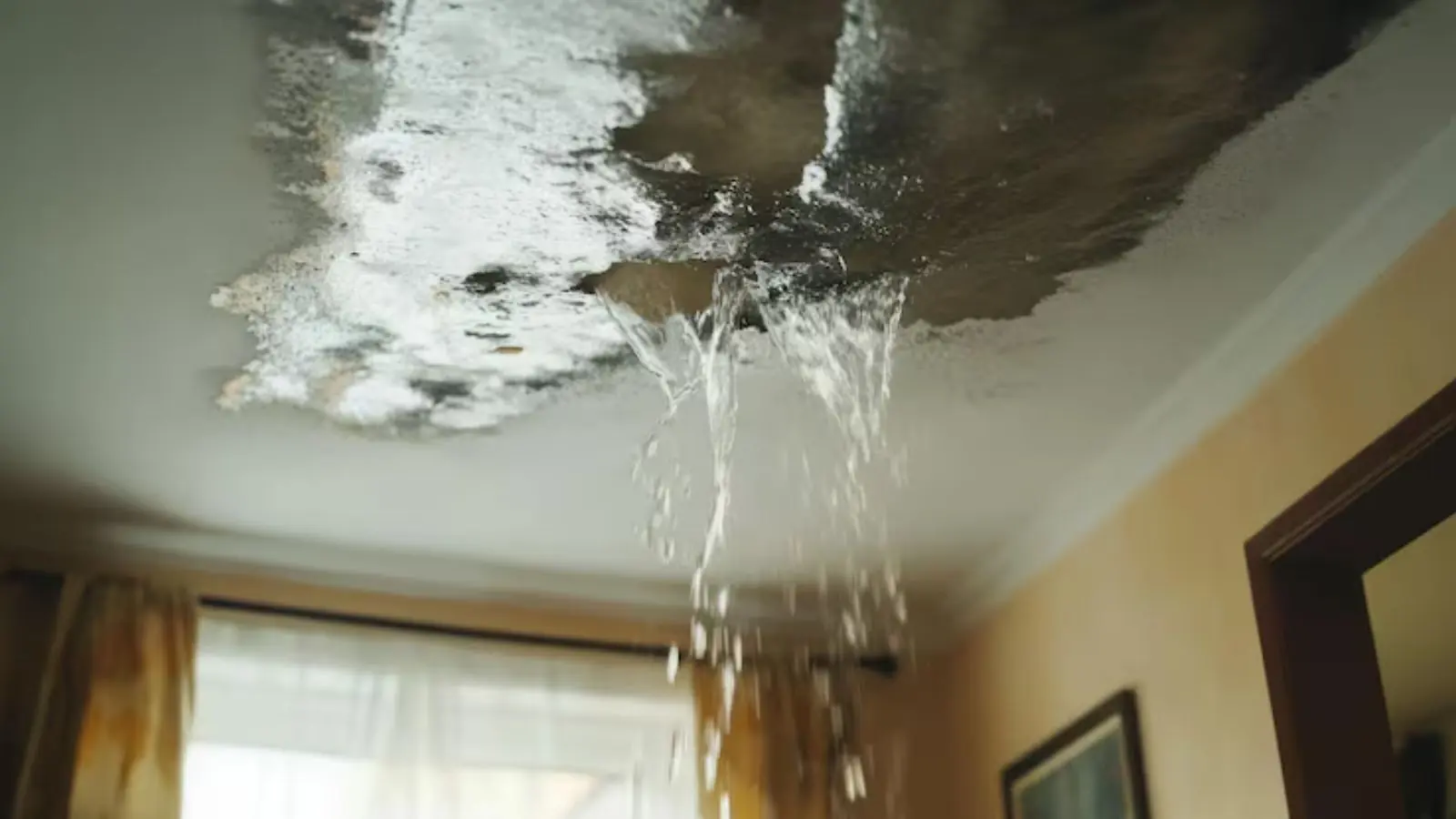
What the stain is telling you
Start with color and shape, because they hold more information than most people expect. A single tan or light brown patch with a soft edge usually comes from one wetting event. Several rings stacked inside each other, like tree rings, point to a leak that has wet and dried repeatedly.
Texture adds detail. Bubbling or peeling paint means water sits behind the paint film, and a bulge or sag means the drywall itself is holding liquid, which is heavy. White chalky crust suggests dissolved minerals drying at the surface, while dark speckled spots on top of a stain can mean growth, which is a separate question that a mold assessment answers better than a guess.
Where ceiling water usually comes from
Water on a ceiling nearly always arrives from above, sideways along a joist, or from condensation. The table pairs what you see with the usual suspects and the sensible first move. Treat the likely source as a starting guess, not a diagnosis.
| What you see | Likely source | First step |
|---|---|---|
| Brown ring under a bathroom on the floor above | Tub or shower seal, supply or drain line | Stop using that fixture and check the shutoff valves |
| Stain in a straight line that follows a joist | Pinhole or fitting leak on a supply line in the cavity | Shut the main valve and see whether the meter still moves |
| Spots that appear only during or after rain | Roof leak or failed flashing | Photograph, set a bucket, and call a roofer once it is safe |
| Damp ring near an HVAC register or air handler | Clogged condensate drain line or full pan | Turn the system off and clear or flush the line |
| Drips near a bathroom fan or attic hatch | Condensation or a disconnected duct | Check the attic for loose ducting when it is safe to enter |
| Sagging with active dripping | Large volume trapped above the board | Stay out from under it, shut off the supply and call right away |
How to trace the source
Begin with timing. If the stain grows during showers, suspect the bathroom above. If it grows only after rain, look at the roof, and if it appears when the air conditioner runs, look at the condensate line. Keep a note of dates, since a pattern is worth more than any single guess.
Then verify. Turn off every fixture and appliance that uses water, then read your water meter and check again in 15 to 20 minutes. A moving dial means water is escaping somewhere, and a stationary one means the leak is probably rain, condensation or a drain, not a pressurized line.
Use a meter and a flashlight
A moisture meter run across the ceiling will outline the wet area more accurately than the stain does, because damp drywall often reaches well past the visible mark. A flashlight in the attic can show dark, wet insulation or a damp rafter. A thermal camera is a useful screening aid, though it shows temperature differences, not moisture itself.
Call (424) 550-5662 and our 24/7 dispatch line answers. Tell us which room the stain is in and whether it is growing.
What to do the same day
- Clear the room of people and pets and stay out from under any bulge or sag.
- Put a bucket under any drip and a tarp or plastic over furniture, then move what you safely can.
- Shut off water to the suspected fixture, or the main valve if you cannot tell.
- Photograph the stain, the room and any damaged belongings, with dates.
- Call the restoration line. If water is dripping fast, ask about emergency water removal before anything else.
Light fixtures and outlets in a wet ceiling
If water is dripping from a light fixture, ceiling fan or vent, do not touch the switch. If a light fixture is dripping, switch its circuit off at a dry panel or leave it alone and call the utility, and never touch a wet fixture. Never stand in water to reach a panel.
What not to do
- Do not paint over the stain until the source is fixed and the drywall reads dry.
- Do not poke holes in a sagging ceiling unless a professional has checked for wiring above it.
- Do not run a regular vacuum on wet carpet or standing water.
- Do not assume a stain that has dried is a stain that is finished, because the cavity may still hold moisture.
Once the water is stopped and the area is dry, rebuilding is straightforward. Our water damage repair page describes how drywall, texture and paint are handled, and the right time for that step is after a meter says the ceiling is ready. For leaks that began upstairs in a Category 2 or 3 situation, ask the crew how contaminated material will be handled before it comes down.
Harbor City details worth knowing
Harbor City is a neighborhood of the City of Los Angeles, bounded by Sepulveda Blvd to the north, Western Avenue and the Harbor Freeway (I-110) to the east, and Anaheim Street and Palos Verdes Drive to the south. If your ceiling leak sits near one of those lines, confirm whether your address is in Los Angeles before you ask about permits for the repair.
Carson was incorporated in 1968 and is its own city with its own building department, as is Torrance. A home on the other side of a boundary answers to that city's rules rather than the City of Los Angeles, so ask your city building department whether the fix you have in mind needs a permit.
Sources: Wikipedia, City of Los Angeles
Frequently asked questions
Is a brown ring on my ceiling an emergency?
Not always. A dry, old ring may only need sealing and paint. A damp ring, a bulge or any dripping should be treated as active, so shut off the likely source and call.
Can the leak be in a different room from the stain?
Yes. Water follows joists, pipes and the top of walls before it reaches a spot where it finally shows. The stain marks where water exited the ceiling, not always where it started.
Does a stain on the ceiling mean mold?
Not by itself. A stain is a record of water, and mold needs moisture to grow. If you see fuzzy or speckled growth, or the area stays damp, ask about a mold assessment that follows S520 practice.
Will insurance cover a ceiling leak?
It depends on your policy and the cause. A stain from a one-time failure may fall under your policy while a long-running seep may not, and dated photos help show which one you have. Check your policy, ask your insurer, and keep dated photos.
I live near the Harbor City edge, so which city do I ask about a ceiling repair permit?
Harbor City is part of Los Angeles, so LADBS is the office that answers permit questions. If your address is in Carson, Torrance or Lomita, ask that city's building department instead.