
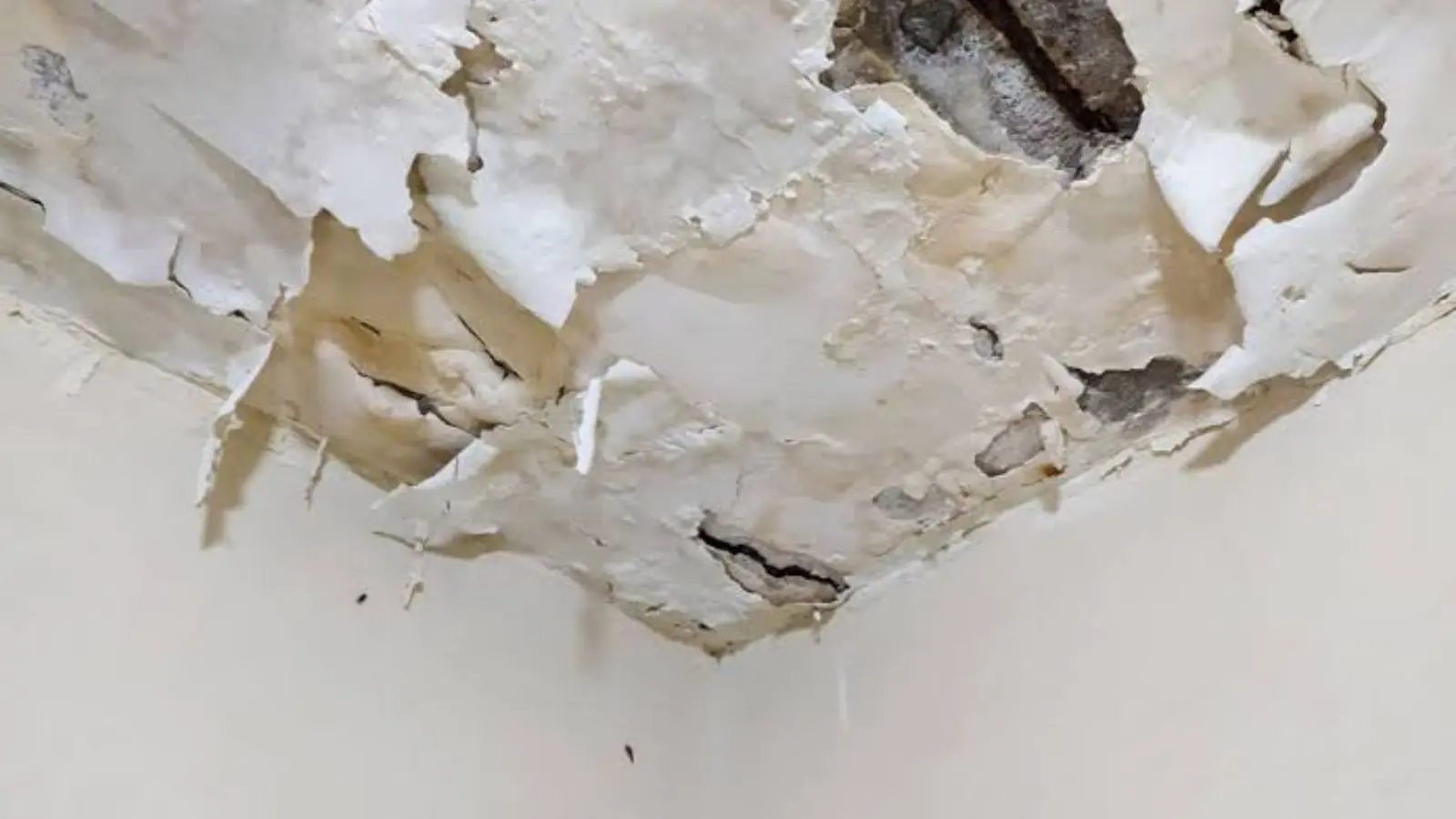
Start by proving the ceiling is dry
Every ceiling repair that fails early fails for the same reason: someone patched over material that was still damp. Before you cut or paint anything, read the area with a moisture meter and compare the number with a ceiling in a dry room of the same house. A thermal camera helps too, since wet drywall shows up cooler than its surroundings.
Give it time. A ceiling that looked wet on Monday may read dry on Friday after fans and open windows, and a stain that darkens again after the next shower means the source is still active. Fix the leak first, and if the area was soaked, water damage cleanup comes before any cosmetic work.
Tools and materials you will want
- A pin or pinless moisture meter, plus a flashlight for the attic or crawl space above
- Drywall saw, utility knife, and a stud finder to locate joists
- Replacement drywall that matches the existing thickness, usually 1/2 inch or 5/8 inch
- Drywall screws, paper or mesh tape, and setting-type and all-purpose joint compound
- Shellac-based or oil-based stain-blocking primer, since ordinary latex primers often let tannin stains bleed through
- Texture materials: spray texture in a can for small popcorn patches, or thinned compound for knockdown
- Dust mask, safety glasses, drop cloths and a sturdy ladder or scaffold plank
The order of work
Out-of-order work is what leaves ghost rings and visible seams. This is the sequence most repair carpenters follow once the readings are good.
Cut out the damaged section
Mark a square or rectangle that reaches past soft, stained or crumbling board, and cut it out. Aim to land the edges on joists, or add wood backing strips to screw the patch to.
Check what is above
Look at the insulation and framing exposed by the opening. Wet insulation is replaced, and framing should read dry before anything closes it back up.
Install the new drywall
Cut a patch to fit with a small gap, screw it to the backing, and set the screw heads just below the surface without tearing the paper.
Tape and mud in thin coats
Embed tape over the seams, then apply two or three thin coats of compound, letting each dry fully and sanding lightly between them.
Block remaining stains
Brush stain-blocking primer over any stain that stays and over the fresh patch, extending a few inches beyond the repaired edge.
Match the texture, then paint
Apply texture to blend with the ceiling, let it cure, then roll two coats of ceiling paint across the whole plane so the patch does not flash.
Matching popcorn and knockdown texture
Texture is where most patches give themselves away. For knockdown, thin joint compound until it flows from a hopper sprayer or stiff brush, spatter it on, wait for the shine to flatten and then drag a wide knife lightly across the peaks. Practice on cardboard first, because timing matters more than force.
Popcorn is a separate problem. Small repairs can be blended with spray-can acoustic texture, but popcorn on older ceilings can contain asbestos, so do not scrape, sand or cut it until a lab confirms what it is. That single question is a good reason to stop and call someone.
Call (424) 550-5662 any hour. The scope is explained before work starts, and we can write up the repair separately from the drying.
When it is a homeowner job and when to call a pro
A small patch of Category 1 damage, under about a square foot or two, in a single room with no fixtures nearby, is a fair weekend project. You need a confirmed dry reading, a steady ladder and patience with drying times between coats.
Bring in a pro when the ceiling sags, when the water came from a drain or sewage line, when the area is large, or when recessed lights or a ceiling fan sit in the wet zone. Our water damage repair team handles the framing, drywall, texture and paint as one coordinated scope, and crews from nearby San Pedro and Harbor City work the same way.
Electrical and sewage safety
If water has reached a light fixture, an outlet or the panel, stay out of the room. Before anyone climbs a ladder, make sure the circuit feeding that ceiling is off at a panel you can reach dry, and leave wet light fixtures to an electrician. Sewage means stay out and call a professional.
A realistic order and timeline for the job
Joint compound dries in layers, so the repair stretches over several days even though the actual labor is only a few hours. Expect a day for cutting and hanging, a day or two for taping and mudding, and another for primer, texture and paint. Humid weather slows every coat.
Cost depends on the area, the materials removed, how much insulation was affected and whether texture has to be matched across a whole room. Ask any contractor to write those items down, and ask your insurer what it needs before you start. Photos taken before the cut help later.
Harbor City details worth knowing
LADBS, the Los Angeles Department of Building and Safety, runs permitting online through PermitLA for simple projects and ePlanLA for projects that need plans. Plumbing is among the permitted work it lists, so opening up piping may need one. If fixing your leak means opening up piping, ask LADBS whether your repair needs a permit before work begins.
LADBS also keeps a San Pedro office at 638 S. Beacon St, San Pedro 90731, if you prefer to ask in person. Whether you apply online or visit, a contractor you hire should be able to say who is pulling any permit.
Sources: LADBS (dbs.lacity.gov)
Frequently asked questions
How long should I wait before patching a wet ceiling?
Wait until a moisture meter reads close to a dry reference ceiling in the same house, and until the source is fixed. That often takes several days, but the number matters more than the calendar.
Will paint alone cover a water stain?
Usually not. Ordinary paint lets brown rings bleed through. A stain-blocking primer under the paint is the standard fix, and it only works once the area is truly dry.
Does the whole ceiling need repainting?
A coat across the entire ceiling plane in the room gives the most even finish. Spot painting a patch tends to show as a different sheen or shade under side light.
Can I use a thermal camera instead of a meter?
A camera shows temperature differences that suggest moisture, but it does not measure it. Use it to find the area and a meter to confirm the numbers.
Who do I ask about permits for a ceiling repair in Harbor City?
A quick question to LADBS settles whether a permit applies. Harbor City is part of the City of Los Angeles, so these rules apply here.